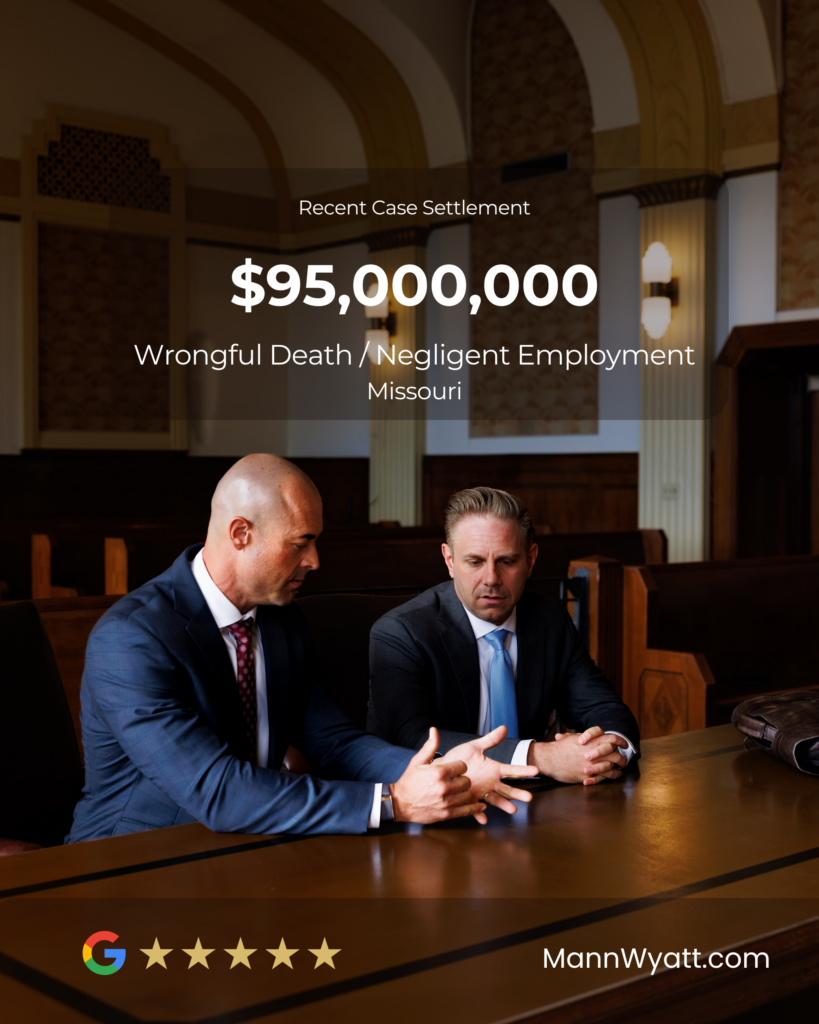
Mann Wyatt Tanksley Injury Attorneys Recent Wrongful Death Settlement
A Missouri mother will never get her son back. But the national retailer that hired the wrong employee and never adequately trained him has now paid $95 million to the young man’s five heirs for what that decision cost his family. Mann Wyatt Tanksley Injury Attorneys, working in co-counsel collaboration, recently secured the settlement on wrongful death and survival action claims for the young man's mother. Here is how it happened, and what it means for anybody who is a customer at a retailer that doesn’t adequately background check its employees.
An accusation that had nothing to do with him
The young man's friend was accused of shoplifting. Large retailers see that every day, and every major chain writes a policy for it: report it, document it, and let law enforcement handle the rest. Nearly every loss-prevention policy in the country forbids employees from chasing suspects out of the store, because the moment a confrontation moves to the parking lot, the risks for all involved increase.
The store’s employee ignored that policy. He chased both of them outside the store and, in the confrontation that followed, he attacked our client’s son who was merely trying to get out of the way.
The young man did not fight. He did not run. He did not resist. The employee aggressively restrained him anyway, leading to the young man’s death from asphyxiation.
The retailer hired the wrong person
When the team investigated, the question quickly shifted from what the employee did to why the retailer ever gave him the job. The company hired, promoted, and kept an employee whose record included violent crime. Those are not footnotes on a background check. They disqualify someone from any position of authority over customers and employees, and especially from a job that involves responding to and investigating alleged theft.
That failure sits at the heart of a negligent hiring and retention claim. The law requires an employer to use reasonable care when it decides whom to hire and whom to keep. When an employer knows, or should know, that an employee poses a danger to the people he will encounter on the job, and places him in that job anyway, the employer shares responsibility for the harm he causes.
The lawyers built the case on three failures:
- Negligent hiring and retention. The retailer placed an employee with a known violent history in a retail store where he would be around customers all day long.
- Policy violations the retailer failed to prevent. The employee broke the company's own rules when he pursued a suspect outside and when he used physical force, and the company had no working system to stop him.
- Inadequate training and policies. The employee was never properly trained in de-escalation or safe restraint.
Excessive use of force is not just a police issue
Most people hear the phrase excessive use of force and think of law enforcement. But the law holds private employees to a standard too. A store has no authority to detain someone for a crime he did not commit, and no authority to use more force than the situation reasonably requires, even against an actual suspect. When an employee restrains a compliant, non-resisting person, he is not preventing a loss. He is committing an assault. And when that assault ends in death, the law calls it a wrongful death.
Wrongful death and survival action: two claims, one loss
Missouri law gave this family two separate paths to accountability, and the settlement resolved both.
- A wrongful death claim belongs to the surviving family. It compensates them for losing their loved one: his companionship, his support, his guidance, and the life they expected to share with him.
- A survival action belongs to the young man himself, and his estate brings it on his behalf. It recovers for what he personally endured between the moment the employee restrained him and the moment he died: the fear, the pain, and the awareness of what was happening to him.
Both claims matter, because together they address the losses of the family and the victim. The family lost him. And before they lost him, he suffered.
Why this settlement reaches beyond one family
A $95 million settlement does more than compensate a family. It puts a price tag on a business decision, and national retailers pay attention to price tags. Every retailer operating in the Midwest now has a concrete reason to look hard at who runs its stores, to enforce the loss-prevention policies it already wrote, and to train its managers on the use of force. That scrutiny protects customers.
What families should know
If you lost a loved one after a confrontation with store security, a manager, a bouncer, or any other employee of a business, the business itself may bear responsibility, not just the individual. These cases turn on evidence that can disappear fast. Surveillance video gets overwritten. Body-cam footage is deleted. Personnel files stay locked until a lawsuit forces them open. Witnesses move on. The sooner an attorney sends preservation demands and begins investigating, the stronger your case can become.
Mann Wyatt Tanksley Injury Attorneys represents families in wrongful death cases across Kansas, Missouri, and the Midwest. If you believe negligent hiring, inadequate training, or excessive use of force played a role in a loved one's death or serious injury, contact us for a free, confidential consultation. We will listen, we will tell you honestly whether you have a case, and if you do, we will fight for the full accountability your family deserves.
The choice of a lawyer is an important decision and should not be based solely upon advertisements. Past results afford no guarantee of future results. Every case is different and must be judged on its own merits.